Viennale: red shirley
one (if not the climax) of the Viennale, took place yesterday in his Gartenbaukino performance: the Viennale director Hans Hurch could welcome lou reed and screening of his film red shirley .
basically a small, fine piece of oral history, the lou reed interview with the capture of his now 102-year-old cousin Shirley. what is now not the major would be art, because you a story like that of Shirley applications already get out of astonishment over all the already would follow curious: Born in Poland, WK just experienced there I, in 1928 emigrated - 19 years old, alone, armed with two suitcases and no English - to Canada, which was then seen as too parochial, making them illegal on to new york, traveled there as a seamstress gained a foothold in the textile industry (including a dress made for Liza Minnelli), and finally in the Italian trade union led the resistance ... however, proves reed heart and humor, if he asks for details shortly, noting that the now well you can not be serious ( cheating? ), he shows that he is about the person rather than with the story. Now what are probably some critics surveyed, because that would be after all the documentary requirement for . However, one gets the impression that lou reed his movie as not intended to be understood. red shirley should definitely not be documented in the traditional sense, it is a love letter a remarkable woman.
the subsequent audience discussion with Hans Hurch and Edek Bartz (for whatever reason the man as took part ...) then was sometimes quite funny to hear. Hurch exhausted himself in technical details, Bartz tried it on the history - reeds answer came in the most scarce. after he had his nose full of it, he directed a short hand to the audience ask about - maybe we should end our little talk here which had now, however, not led to much more detailed statements. Well, mr. Reed does not seem the words of the great man, however: a good teller he was always on the lips ...
Wednesday, November 3, 2010
Tuesday, November 2, 2010
Rent Basketball Courts New Jersey
Viennale: curling
in the audience discussion after the screening of his film in the cinema led gardening, the extremely likeable Denis Côté from what he was getting in filmmaking - namely, about making movies, which arise from their reading. and that in each head again. in another way, because other habits reception aptly evoking fantasies or other ... why his movies are exclusively concerned with the present. No flashbacks, no narrative punch or-volt, dramatic tricks. This logic is inherent in a principled openness - and in all directions: forward and back, open right in the middle episodes. nothing is brought to an end, can be end be brought. nothing is self-explanatory but it is about mood, a setting to move to something, never about anything.
curling in a father give his daughter some 12 years of the setting. they live somewhere in Canada, somewhat away from the resort. on a highway, where cars drive by every now and then. around fields and forests, snow-covered. the father does maintenance work in a bowling hall and a cleaner in a motel. his daughter, he tries to think of the environment largely to far away, so he taught them at home. He speaks of evil out there. One day, the daughter of a pile of corpses in the adjacent forest - after first running away, she goes again to (their) balance, makes friends with them. the father takes on the way home on the street a child who was hit. he brings the car home. when he arrives is to bring this motion died two encounters in the frozen microstructure of father and daughter make things needed to change ...
coté can with the time settings, it has no hurry. Father and daughter walking through the lonely, stormy winter landscape. a police car overtook them slowly, then stops across them before. the policemen, it is strange that both are moving on foot dei - ask them where they are from, where they are traveling, why: on foot? He offers to take it with you the father refuses ... ordinary people, but somehow not ...
in the audience discussion after the screening of his film in the cinema led gardening, the extremely likeable Denis Côté from what he was getting in filmmaking - namely, about making movies, which arise from their reading. and that in each head again. in another way, because other habits reception aptly evoking fantasies or other ... why his movies are exclusively concerned with the present. No flashbacks, no narrative punch or-volt, dramatic tricks. This logic is inherent in a principled openness - and in all directions: forward and back, open right in the middle episodes. nothing is brought to an end, can be end be brought. nothing is self-explanatory but it is about mood, a setting to move to something, never about anything.
curling in a father give his daughter some 12 years of the setting. they live somewhere in Canada, somewhat away from the resort. on a highway, where cars drive by every now and then. around fields and forests, snow-covered. the father does maintenance work in a bowling hall and a cleaner in a motel. his daughter, he tries to think of the environment largely to far away, so he taught them at home. He speaks of evil out there. One day, the daughter of a pile of corpses in the adjacent forest - after first running away, she goes again to (their) balance, makes friends with them. the father takes on the way home on the street a child who was hit. he brings the car home. when he arrives is to bring this motion died two encounters in the frozen microstructure of father and daughter make things needed to change ...
coté can with the time settings, it has no hurry. Father and daughter walking through the lonely, stormy winter landscape. a police car overtook them slowly, then stops across them before. the policemen, it is strange that both are moving on foot dei - ask them where they are from, where they are traveling, why: on foot? He offers to take it with you the father refuses ... ordinary people, but somehow not ...
Monday, November 1, 2010
White Women Wigs At Work
Viennale: Meek's cutoff
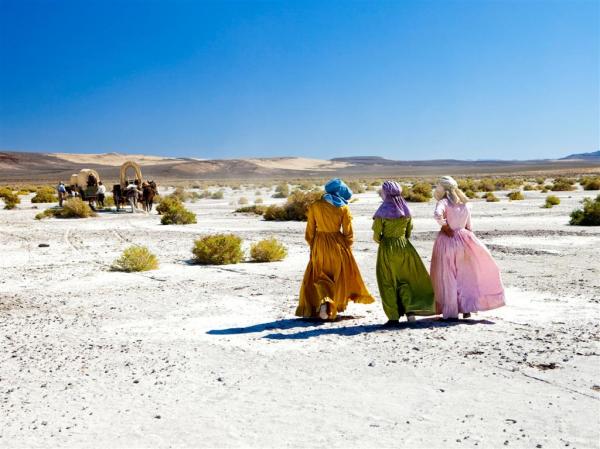
Kelly Reichardt uses the genre against itself: the setting - provided with all the genre-typical ingredients - is easily explained. three families of settlers and their scout Meeks (based on a historically verifiable figure), who speaks in favor of the legendary Oregon Trail an abbreviation leave are on the way to the west. However, settings at the first is clear, Reichardt it's certainly not a possible dramatic presentation of the painful everyday settlers: the camera patiently follows the crossing of a river, a team of oxen after the other, behind the women on the head, transporting fragile items carefully. is at the other shore collected wood, water resources are filled, the adolescent boy scratches in an old weathered tree trunk the word lost.
which basically everything is explained. It is reichardt the presentation of this lost one - and the impact on this common destiny: after a few days without water, the settlers anxious - to the capabilities of the scouts are logged doubt. then even as an Indian shows up, the meeks captures with a settlers, differ on how to proceed with him, Meeks wants to kill him immediately, the settlers rely on its local knowledge and can lead him on. however, the fear that the Indians could lead to an ambush, always present. what the psychological film is a structural crisis: the women at the beginning of the film are some steps fro behind the venture, which - if the men advise on further action - wait in the background and ask themselves to decide what will be tone - in the literal sense to take the reins ...
in this new world, because - not where a gold fund in view of existing water-nothing matters must be reconsidered old power structures, Authorities questioned and loyalties are redefined. Reichardt delivers a dense, very gently stretch over long incredibly quiet portrait of these survive in the absolute barrenness around the struggling company.
Subscribe to:
Posts (Atom)